
TFSA, FHSA, RRSP — the decision tree for newcomers earning $100K+ in Canada
If you land in Canada with a tech-job paycheque and no idea which registered account to open first, the standard advice you'll find online is some variant of "well, it depends on your situation." Useless.
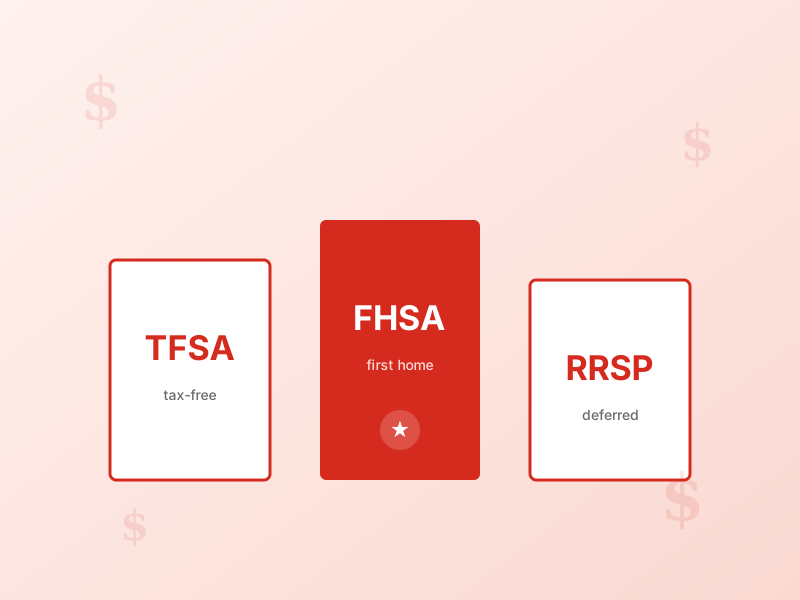
The real answer for the majority of newcomers earning $100,000+ is a clean priority order: FHSA → TFSA → RRSP. This article shows the math behind that order, the exceptions, and the specific traps the first-year-in-Canada crowd falls into. Every number below links to a Canada Revenue Agency primary source.
Which registered account should a newcomer earning $100K+ open first in Canada?
Open the FHSA first if you plan to buy a Canadian home within 15 years. The FHSA combines RRSP-style tax deductions with TFSA-style tax-free growth and withdrawals — uniquely powerful. Contribute up to $8,000 per year, $40,000 lifetime. After maxing FHSA, fund TFSA next ($7,000 of room per year). RRSP comes last in year one because you have zero RRSP room until the year after you earn Canadian income.
The order matters because each dollar can only sit in one account. At $100K+ income in BC or Ontario, your marginal tax rate is roughly 38–43% combined federal-plus-provincial. Every $1,000 of FHSA contribution saves you about $380–$430 in tax that year, and the growth inside the account is never taxed. TFSA gives you the tax-free growth but no upfront deduction. RRSP gives you both, but every withdrawal is fully taxable as income — and you have no room anyway in year one.
What is a TFSA, and how does it work for newcomers?
A Tax-Free Savings Account (TFSA) lets you contribute after-tax money, then grow and withdraw it tax-free forever. For 2026, the annual contribution limit is $7,000. Contribution room begins the year you become a Canadian tax resident at age 18+ — not your year of birth — and unused room carries forward indefinitely.
The TFSA is Canada's most flexible registered account. You can invest it in stocks, ETFs, bonds, GICs, or cash. You can withdraw any amount any time without tax. Withdrawals are added back to your contribution room the following January — over-contributing the same year you withdraw is a common newcomer mistake that triggers a 1% per month penalty (CRA: TFSA contributions).
Three TFSA facts newcomers get wrong:
- Your TFSA room starts the year you become a Canadian tax resident, not the year you were born. If you arrived in 2026 at age 35, your TFSA room for 2026 is $7,000 — not the $109,000 cumulative limit available to lifelong Canadians since 2009.
- You can still contribute even without Canadian income. You can use your foreign savings — TFSA contributions don't depend on having earned Canadian income (that's an RRSP rule, not a TFSA rule).
- Do not day-trade inside your TFSA. The CRA has reassessed accounts as "carrying on a business" and stripped tax-free status. Long-term investing is fine; high-frequency trading is not.
What is an FHSA, and why does it usually beat TFSA for newcomers?
The First Home Savings Account (FHSA) is the newest registered account (launched 2023) and the single most powerful one for newcomers planning to buy a home. Contributions are tax-deductible like an RRSP, and qualifying withdrawals for a first home purchase are tax-free like a TFSA. Contribution limit: $8,000 per year, $40,000 lifetime. Unused room carries forward up to $8,000.
At a 38% marginal tax rate, an $8,000 FHSA contribution saves you roughly $3,040 in tax the same year — money you can roll right back into the next FHSA contribution or your TFSA. Over the $40,000 lifetime maximum, that's about $15,200 in tax savings on top of the tax-free growth (CRA: FHSA overview).
Critical newcomer-specific rule: FHSA contribution room only starts accumulating the year you open the account. You can't retroactively claim room for years before you opened it. So if you arrived in Canada in 2026 and don't open an FHSA until 2027, you've permanently lost the 2026 $8,000 room. Open the account in year one even if you can't fund it yet — it costs nothing and starts the 15-year clock.
The FHSA must be used for a first home in Canada (or rolled into your RRSP if you don't end up buying). "First home" means you haven't owned a home you lived in during the current year or the previous four calendar years — most newcomers easily qualify even if they owned property abroad.
When does an RRSP actually beat the other two?
Use RRSP over TFSA when your current marginal tax rate is meaningfully higher than your expected retirement marginal rate — typically at $100K+ income. RRSP also wins instantly if your employer matches contributions: a 50% match doubles your money before you've even invested it. Otherwise, TFSA is the more flexible default in year one because you have no RRSP room.
The RRSP math is a bet on tax-rate arbitrage. You contribute when your marginal rate is high (say 43% in BC at $120K), and you eventually withdraw when your marginal rate is lower (say 24% in retirement). The difference is real money. For a newcomer in tech earning $120K-$200K+, this arbitrage is usually positive.
The catch: in your first calendar year as a Canadian tax resident, your RRSP contribution room is $0. Room equals 18% of your prior-year Canadian earned income, capped at $33,810 for 2026 (CRA: RRSP contribution limit). Year one = no Canadian prior-year income = no room. The room appears in year two based on year-one earnings.
One exception: if your employer offers a Group RRSP with a match, you can usually contribute via payroll deduction even in year one, and the match is taken against future RRSP room. Check with your HR — the match is almost always worth it.
Year-one math: how much can a newcomer actually contribute?
A newcomer who arrives in January 2026 and opens both accounts immediately can contribute $7,000 to a TFSA and $8,000 to an FHSA in their first calendar year — $15,000 of registered room total. RRSP room is $0 in year one unless your employer matches. In year two, RRSP room appears at 18% of your year-one Canadian earned income.
Concrete example. You move to Vancouver in March 2026, earn $130,000 of Canadian salary that calendar year, and have $50,000 of savings in another currency:
- 2026 (year one): open both accounts in March. Fund $8,000 FHSA (using your foreign savings, converted via Wise or Norbert's Gambit, not the bank teller). Claim $8,000 FHSA deduction on your 2026 tax return — saves about $3,040 in tax at a 38% marginal rate. Fund $7,000 TFSA. RRSP room is $0, so no RRSP contribution from personal funds. If your employer offers a Group RRSP match, take it — typically 3–5% of salary.
- 2027 (year two): RRSP room appears at 18% × $130,000 (year-one Canadian earned income) = $23,400. Fund another $8,000 FHSA + $7,000 TFSA + as much RRSP as you can from year-one tax refund and current paycheque.
- 2028 (year three): by now you have $24,000 in FHSA contributions ($16K from years one and two plus year three), $21,000 in TFSA, and RRSP room compounding. Total registered shelter: roughly $70K+ in three years.
What if my employer matches RRSP contributions?
Take the full match before doing anything else — it is the single highest-return move in personal finance. A 50% employer match is an instant 50% return on day one. Most Canadian employer Group RRSPs allow contributions via payroll deduction even without personal RRSP room (the match comes out of future room). Confirm with HR; never leave the match on the table.
Order of operations when there's a match: (1) contribute enough to Group RRSP to capture the full employer match, (2) max the FHSA, (3) max the TFSA, (4) any additional RRSP via personal contributions if you still have room. Even at $100K+ income, the employer match beats FHSA on pure return — but you should still max FHSA after, because FHSA at $8,000/year is small relative to the RRSP-match decision.
Five mistakes newcomers make in their first year
The most common newcomer money mistakes in year one: (1) not opening an FHSA at all, (2) day-trading inside a TFSA, (3) trying to contribute to an RRSP they don't have room for, (4) holding US-listed dividend stocks in a TFSA (the IRS withholds 15%), and (5) converting savings via a big-five bank instead of Wise or Norbert's Gambit. Each one is expensive, and each is easy to avoid.
- Not opening the FHSA in year one. Room only accumulates after you open the account. Open it day one, even with a $0 balance.
- Day-trading inside a TFSA. CRA can reassess as business income. Long-term ETFs and stocks: fine. Daily options trading: a tax nightmare.
- Over-contributing to RRSP. Year one has $0 room. Personal contributions trigger a 1% per month penalty on the excess. Use Group RRSP through payroll only.
- US dividend stocks in TFSA. The US-Canada tax treaty exempts RRSPs from the 15% US dividend withholding tax, but not TFSAs. Hold US dividend-payers in your RRSP; hold non-dividend US growth or Canadian dividends in your TFSA.
- Converting CAD via a bank branch. Big-five FX spread is 1.5–2.5% on top of the published rate. On $50K converted, that's $750–$1,250 — almost a maxed FHSA gone before you start. Use Wise (referral), Wealthsimple Cash USD (referral), or Norbert's Gambit.
The 5-step newcomer playbook
The clean 5-step sequence for a newcomer earning $100K+ in their first calendar year: (1) open FHSA and TFSA the same week you get a SIN, (2) enroll in any Group RRSP with an employer match, (3) fund $8,000 FHSA from foreign savings (converted via Wise, not the bank), (4) fund $7,000 TFSA, (5) file your first Canadian tax return by April 30 to claim the FHSA deduction and establish year-two RRSP room.
- Open both accounts the same week you get your SIN. Wealthsimple, Questrade, and the big-five banks all offer FHSA and TFSA. Wealthsimple is the easiest for newcomers — fully digital, no in-branch appointment needed.
- Enroll in any Group RRSP with employer match. Sign up at your first HR onboarding meeting. Set contribution to whatever maxes the match.
- Move your foreign savings via Wise or Norbert's Gambit. Not the bank teller. Save 1.5–2.5%.
- Fund FHSA ($8,000) and TFSA ($7,000) by December 31. Even if you only have one paycheque worth in Canada, use foreign savings.
- File your first tax return by April 30. Claim the FHSA deduction (saves $2,400–$3,400). Filing also establishes RRSP room for year two and unlocks the GST/HST credit ($519+ per adult, paid quarterly).
Where to go next
For the broader picture, see the complete newcomer money guide. For the FX side of getting your savings into Canada cheaply, Issue 03 (publishing May 24, 2026) walks through Norbert's Gambit step-by-step on Wealthsimple, Questrade, and Interactive Brokers — landing in your inbox next Sunday.
Got a question this issue didn't answer? Reply to any First Year Canada email or write to [email protected]. Reader questions become future issues.
— Sushil