
Your first Canadian tax return as a newcomer — the credits you're owed, and how to file
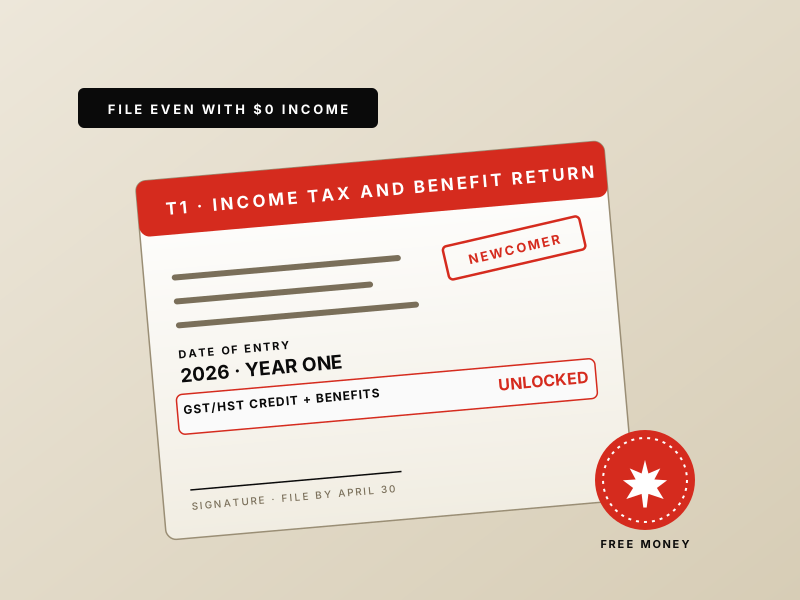
Here's the mistake almost every newcomer makes in their first year: they arrived partway through the year, earned only a few months of Canadian income (or none at all), and concluded there's no point filing a tax return until next year. That's backwards.
In Canada, your tax return is not just how you pay tax — it's how the government figures out what to pay you. The GST/HST credit, the Canada Child Benefit, provincial credits, and your FHSA deduction all flow from a filed return. Skip it and you quietly leave hundreds or thousands of tax-free dollars on the table. Every number below links to a Canada Revenue Agency primary source.
Do I even have to file a Canadian tax return in my first year?
If you owe tax, yes — you must file. But even if you earned little or no Canadian income, you should still file, because filing is how the CRA calculates the benefits you're entitled to: the GST/HST credit, the Canada Child Benefit, and provincial credits. Skipping your first return usually means leaving tax-free government money unclaimed. The deadline is April 30 of the year after you arrived.
The Canadian system is built around an annual return that does double duty. It reconciles the tax withheld from your paycheques against what you actually owe (often producing a refund in a part-year first year, because withholding assumed you worked all 12 months). And it acts as your yearly application for income-tested benefits. No filed return means the CRA has no income figure to test against — so the benefits simply don't get paid (CRA: Newcomers to Canada).
What "newcomer" means on your tax return
For your first return you file as a newcomer (the CRA's word for a first-year tax resident). You became a Canadian tax resident on the day you arrived with the intention to settle — your date of entry. You report that date on page 1 of the return, and it's the single most important entry on the whole form: it defines your part-year residency and how your credits are prorated.
You don't become a tax resident on some abstract legal date — for most newcomers it's simply the day you landed and established residential ties (a home, a spouse or dependants here, a Canadian bank account, a provincial health card). From that day you're taxed like any other resident. Before that day, Canada generally doesn't tax you. The CRA's newcomer guide, T4055 — Newcomers to Canada, is the authoritative walkthrough and worth 20 minutes of your time.
The credits you're owed just for filing
Filing unlocks the GST/HST credit — roughly $519 per adult plus about $179 per child each year (2023 base-year amounts, indexed annually), paid quarterly and tax-free. Families with children can also receive the Canada Child Benefit. Several provinces add their own credits on top, paid alongside the federal ones. None are automatic — the CRA needs a return or a newcomer application on file to start paying.
Two of these you can claim before you've even filed a full return, in your arrival year:
- GST/HST credit — as a newcomer, apply with Form RC151 for the year you became a resident (you have no prior return for the CRA to base it on yet). After your first filed return, it renews automatically each year (CRA: GST/HST credit).
- Canada Child Benefit (CCB) — if you have kids, apply with Form RC66 plus the status schedule. The CCB is tax-free, paid monthly, and income-tested — for lower-income newcomer families in year one it can be substantial (CRA: Canada Child Benefit).
One myth to kill: despite what older newcomer guides still say, do not count on a federal carbon rebate. The consumer carbon price was removed in 2025 and the Canada Carbon Rebate's final payment was issued that year — it's gone. Budget on the GST/HST credit and CCB instead, which remain.
Do I report income I earned before I landed in Canada?
You're only taxed on income earned after you became a Canadian resident, plus any Canadian-source income. But your return does ask for your income from before that date, in the residency section — the CRA uses it to prorate your credit entitlements for the year, not to tax it a second time. Report your foreign pre-arrival income honestly; understating it to look poorer can wrongly inflate your credits and trigger a reassessment later.
This is the part that confuses nearly every newcomer, so be precise: the pre-arrival "world income" figure goes in the Information about your residency status section of the return. It reduces the personal amounts and credits you can claim for the part of the year before you were a resident. It is not added to your taxable income. Getting this right protects you from an unpleasant CRA letter two years later asking you to pay back over-claimed benefits.
How to actually file your first Canadian return
Start free. The CRA lists certified tax software, including several genuinely free options. Wealthsimple Tax and others let most people file at no cost. The catch for newcomers: your first return often can't be NETFILE'd because the CRA doesn't have you on file yet — so you may have to print and mail it. File by April 30.
The practical sequence for a first return:
- Gather your slips. Your employer issues a T4 by end of February; banks and brokerages issue T5/T3 slips for interest and investments. Log in to CRA My Account once you have a SIN — many slips auto-populate there.
- Pick certified software. Free options handle a typical newcomer return (T4 income, FHSA/RRSP deductions, credits) without paying a cent. Lead with free; you can always upgrade if your situation is complex (US cross-border, self-employment). The tax tool sits inside the same Wealthsimple (referral) app where many newcomers already open their FHSA and TFSA, which keeps everything in one place.
- Enter your date of entry and pre-arrival income. Every certified package has a "newcomer / first return" flow — follow it. If you skip these fields your credits will be miscalculated.
- If NETFILE is rejected, paper-file. Print the return, attach your slips, and mail it to your CRA tax centre. It's slower (weeks, not days) but it's normal for a first return. Next year you'll file online in minutes.
Simple return, employment income only? The CRA also runs a free tax-clinic program (CVITP) where volunteers file for lower-income filers — useful in a lean first year.
Deductions that cut your first-year tax
The big first-year lever is the FHSA deduction: contributions (up to $8,000) are deductible against your income, saving roughly $380–$430 per $1,000 at a $100K income. RRSP deductions generally have to wait — you have no RRSP room until the year after you first earn Canadian income. Tuition, eligible moving expenses, and childcare costs may also reduce what you owe. Claim the FHSA on the return for the year you contributed.
We covered the account priority in Issue 02 (TFSA, FHSA, RRSP decision tree) — the tax return is where that FHSA contribution finally pays off as a deduction. A note that trips people up: your first-year RRSP contribution room is zero, because room is 18% of prior-year earned Canadian income. Filing your first return is what generates the room you'll use in year two, so filing pays forward even when it doesn't cut this year's bill (CRA: RRSP deduction limit).
Mistakes newcomers make on the first return
The recurring ones, in rough order of how much they cost:
- Not filing at all because income was low — forfeiting the GST/HST credit and CCB. The single most expensive mistake.
- Leaving the date of entry blank or wrong, which scrambles the proration of every credit.
- Guessing at pre-arrival world income (or entering $0 to look poorer) — a reassessment magnet.
- Expecting NETFILE to work on the first return and missing the April 30 deadline when it doesn't. Have a paper plan.
- Forgetting foreign property reporting. If you own specified foreign property worth more than C$100,000 (overseas real estate you rent out, foreign investment accounts), you may need Form T1135 — but not for the year you arrive (it starts the year after you become a resident). Check whether it applies to you.
The first-return playbook
The clean sequence: (1) get a SIN and open CRA My Account, (2) apply for the GST/HST credit now with Form RC151 (and CCB with RC66 if you have kids), (3) collect your T4 and other slips in February, (4) file your first return with free certified software by April 30 — paper-file if NETFILE rejects it, (5) claim your FHSA deduction and keep the Notice of Assessment.
- Get your SIN and CRA My Account. Everything downstream needs both. Slips and benefit notices show up in My Account automatically.
- Apply for benefits immediately. Don't wait for tax season — file RC151 (GST/HST credit) and, if you have children, RC66 (CCB) in your arrival year.
- Collect slips in February. T4 from your employer, T5/T3 from banks and brokers. Cross-check against CRA My Account.
- File by April 30 with free software. Use a CRA-certified package, follow its newcomer flow, enter your date of entry, and paper-file if NETFILE won't accept a first return.
- Claim the FHSA deduction and save your NOA. The Notice of Assessment shows your new RRSP room for next year — keep it; you'll need the number in year two.
Where to go next
For the full first-year sequence, see the complete newcomer money guide. If you're moving foreign savings into Canada to fund an FHSA before you file, Issue 03 on Norbert's Gambit shows how to do it without losing 1.5% to the bank. And if a tax bill or refund needs to cross a border, Wise (referral) beats the wire desk on the exchange rate.
This issue is general information, not tax advice — your situation (US citizenship, self-employment, foreign property) can change the answer. When in doubt, a cross-border accountant for one hour is cheap insurance.
Got a question this issue didn't answer? Reply to any First Year Canada email or write to [email protected]. Reader questions become future issues.
— Sushil