
Medical insurance for newcomers in Canada — interim coverage during the 3-month OHIP / MSP wait
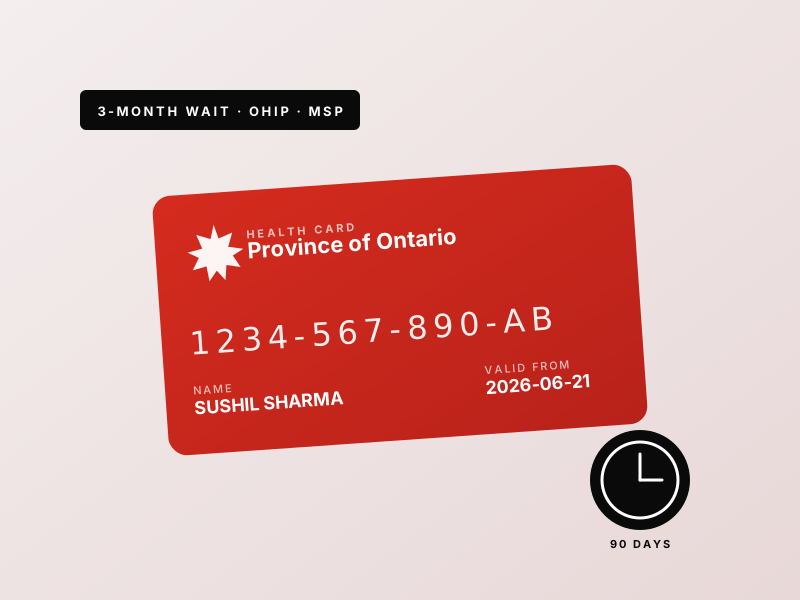
If you're flying to Toronto, Vancouver, or Montreal in the next few weeks expecting Canada's "free healthcare" to kick in the moment you land — slow down. Most provinces make new residents wait 90 days before provincial health coverage starts. If anyone in your family needs an ER visit, an ambulance, or routine specialist care during that window, you pay full price. That bill in Ontario can run from $1,500 for a minor ER visit to $15,000+ for childbirth.
This article is what I wish someone had handed me before I landed. It covers: what the wait actually is by province, what interim insurance to buy, how much it costs, and the four traps newcomers fall into.
Which Canadian provinces have a 3-month wait for new residents?
Seven provinces impose a 3-month waiting period for new residents: Ontario (OHIP), British Columbia (MSP), Quebec (RAMQ), New Brunswick, Nova Scotia, PEI, and Newfoundland. Four provinces and territories cover you immediately: Alberta (AHCIP), Manitoba, Saskatchewan, and Yukon. If you have a choice of which Canadian city to land in, the cost of the 3-month wait should factor in.
The wait starts from the date you "establish residency" — usually your date of arrival with intent to stay. You apply to the provincial health plan the same week you arrive, but coverage doesn't activate until 90 days later. Primary sources:
- Ontario (OHIP): ontario.ca/page/apply-ohip — 3-month wait, apply same day at any ServiceOntario location.
- British Columbia (MSP): gov.bc.ca/msp — 3-month wait, MSP premium is $0 since 2020.
- Quebec (RAMQ): ramq.gouv.qc.ca — 3-month wait, exceptions for certain refugee classes.
- Alberta (AHCIP): alberta.ca/ahcip — immediate coverage from your date of residency.
What interim health insurance should a newcomer buy?
Buy a "Visitors to Canada" or "Newcomers to Canada" policy from Manulife, Sun Life, Allianz, or Blue Cross before you fly, with coverage starting on your arrival date. Target $1 million emergency medical + hospitalization limit, $0 deductible. The 4 major providers are roughly equivalent in coverage; the price difference between them is usually 10–15%, so pick whichever has the simplest claims process. Confirm your employer doesn't already provide this before you buy — some large tech employers cover the gap.
What these policies actually cover:
- Emergency room visits and hospital admissions
- Ambulance transport
- Diagnostic tests (X-ray, MRI, blood work) when emergency-related
- Prescription drugs related to the emergency event
- Repatriation if needed
What they typically do NOT cover:
- Routine doctor visits (you'd self-pay $80–$200, manageable)
- Pre-existing conditions (always read the exclusion list)
- Pregnancy that began before policy start date
- Dental and vision (need a separate plan)
- Mental-health therapy (usually excluded or capped)
How much does interim newcomer insurance cost?
For a healthy adult 30–45 years old with $1 million coverage, $0 deductible, 90-day policy: about $200–$300 total (roughly $2.20–$3.30/day). Per person scales linearly. Family of four = roughly $800–$1,200 for the 90-day period. Older applicants (50+) pay 50–100% more. Adding pregnancy coverage (where allowed) adds 30–50%.
Concrete quotes I just pulled for comparison (June 2026, healthy 35-year-old, $1M coverage, $0 deductible, 90-day policy):
- Manulife Visitors to Canada: ~$245
- Sun Life Visitors: ~$260
- Allianz Newcomers to Canada: ~$220
- Blue Cross Visitor: ~$235
For comparison, a single uninsured ER visit in Toronto for a non-resident averages $1,500–$5,000. The math is not subtle.
What does my Canadian employer's benefits plan actually cover?
Standard Canadian employer benefits are supplemental — they cover prescriptions, dental, vision, paramedical (physio/chiropractic), and sometimes private hospital rooms or health-spending accounts. They explicitly require provincial health coverage (OHIP/MSP/etc.) to be in effect for hospital and physician costs. So they do NOT cover the OHIP/MSP wait period unless your employer has specifically added an "interim insurance" benefit for newcomers. Ask HR.
Three questions to ask your HR on Day 1:
- "Does my benefits plan include coverage for the OHIP/MSP waiting period for new residents?"
- "If yes, when does it activate — date of hire, or date my provincial coverage would normally start?"
- "If no, can the company reimburse a private newcomer policy I buy?"
FAANG and large tech employers (Amazon, Google, Microsoft, Meta, etc.) often have a yes answer — check before buying private.
How to apply for OHIP / MSP / RAMQ when eligible
Apply the week you arrive. The 90-day clock starts on your date of residency, not your application date — so applying early doesn't help, but it also doesn't hurt. You'll need: passport, PR card or work permit, proof of address (lease, utility bill, bank letter), and an in-person visit to a ServiceOntario / Service BC / RAMQ office. Card arrives by mail in 4–6 weeks. Coverage activates exactly 90 days after your residency date.
Province-specific application notes:
- Ontario (OHIP): in-person at any ServiceOntario. Bring physical originals; copies don't count. ID requirements: ontario.ca documentation list.
- BC (MSP): register online at gov.bc.ca enrollment. BC Services Card pickup is in-person.
- Quebec (RAMQ): register online, ramq.gouv.qc.ca registration. French may be required in some offices.
What happens if you get sick during the wait without insurance?
You pay full hospital rates as a non-resident. Rough Ontario uninsured pricing: ER visit $1,500–$5,000, ambulance $240–$400, specialist consult $200–$500, hospital admission $4,000–$8,000 per day, childbirth $5,000–$15,000. Hospitals will demand payment at discharge or set up a payment plan. If you cannot pay, the debt can be sent to collections and affect your Canadian credit file once it's built.
Real-world ranges (Toronto, June 2026, uninsured non-resident rates, sources: Toronto-area hospital published self-pay schedules):
- Routine doctor visit: $80–$200
- ER visit (minor): $1,500–$2,500
- ER visit (admitted): $3,000–$8,000+
- Ambulance (Toronto): $240–$400
- X-ray: $200–$500
- MRI: $800–$2,500
- Specialist consultation: $200–$500
- Vaginal delivery: $5,000–$10,000
- C-section delivery: $10,000–$15,000+
Five mistakes newcomers make with health coverage
The expensive ones: (1) assuming travel insurance covers the full 90-day wait — it usually doesn't once you become a "resident", (2) waiting to buy interim insurance until after arrival — most policies need a buy-before-departure date, (3) skipping interim insurance because "I'm young and healthy" — one ER visit erases the savings, (4) not asking employer HR about interim coverage — many tech employers cover it, (5) applying for OHIP/MSP late thinking the 90-day clock starts at application (it starts at residency date).
- Travel insurance ≠ newcomer insurance. Your standard travel-insurance policy from home covers you as a "visitor." Once you establish residency in Canada — which can be as fast as signing a lease or opening a bank account — most travel policies stop covering you. Read the fine print before you fly.
- Buy before you fly. Most Visitors-to-Canada policies require the start date to be before or on your arrival date. Buying from inside Canada after arrival is often disallowed or excludes any condition that began during the gap. Set the policy effective date to your flight date.
- "I'm young and healthy" math doesn't work. One twisted ankle requiring an X-ray costs $200–$500 uninsured. One ER visit for food poisoning costs $1,500+. The premium for 3 months of $1M coverage is $200–$300. The downside is bounded and small; the upside (no $5K bill) is real.
- Ask employer HR. FAANG-tier and large Canadian employers (banks, telcos, government) often have an interim coverage rider in their benefits plan specifically for relocated employees. Check before you spend $300 on private coverage.
- Apply for provincial coverage Day 1, but understand the clock. The 90-day wait clock starts on your residency date, not on your application date. So early application doesn't accelerate coverage — but it does mean your card arrives sooner after the 90-day mark. Apply the first week regardless.
Where to go next
For Issue 07 (next Sunday) — First apartment in Canada: lease approval, deposits, and the guarantor hack for newcomers with no Canadian credit history.
For the broader first-year sequencing, read the complete pillar guide. For the financial setup that goes alongside arrival (FHSA, TFSA, first credit card), see Issue 02 and Issue 04.
Got a question about health coverage, employer benefits, or anything else first-year-Canada? Drop it anonymously here. Reader questions directly shape what I write next — these last three issues were all reader-requested.
— Sushil