
The right bank account combo for newcomers — no-fee chequing, high-interest savings, and the Big-Five trap
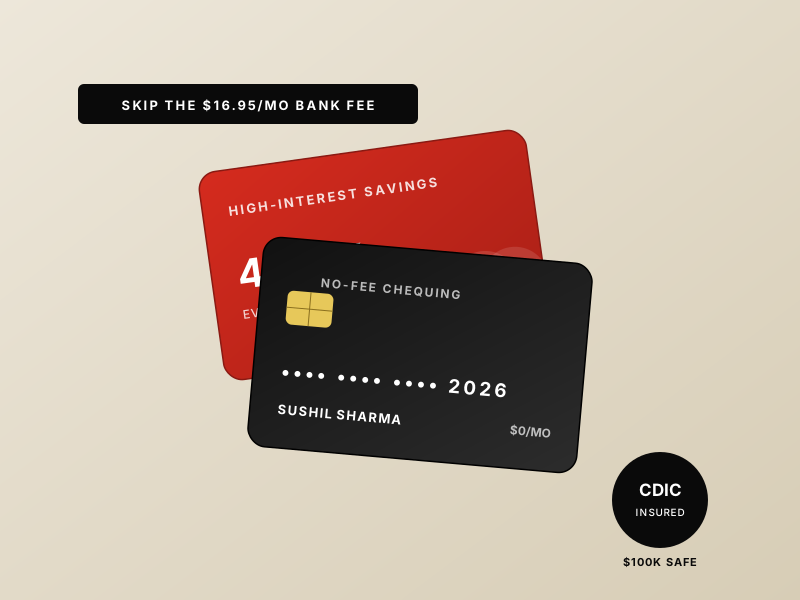
The first thing almost every newcomer does is walk into a big bank branch, because that's what you did back home, and open the "newcomer package" the advisor recommends. It's not a disaster — the perks are real — but it quietly sets you up to pay a monthly fee you never needed to pay, on money that should be earning interest instead.
Canadian banking splits cleanly into two jobs: an account for spending (payroll in, bills and debit out) and an account for saving (money you're not touching this month). Get the right account for each and your baseline banking costs $0 a month while your savings earn a real rate. Here's the combo, the trap to avoid, and how to switch without breaking your paycheque.
Which bank account should a newcomer open first?
Open a no-fee chequing account for daily spending and payroll, plus a separate high-interest savings account for money you're not spending this month. You don't need the Big Five. A newcomer can usually open an account with a passport and PR card or work permit — before you have a job or any Canadian credit history. Keep everyday cash where the monthly fee is $0.
The reason to split spending from saving isn't tidiness — it's that the two accounts optimise for opposite things. A chequing account should be free and frictionless; you don't care about interest on money that's about to leave. A savings account should pay a real rate; you don't care that it's slightly slower to access. Trying to make one account do both is how you end up with everything sitting in a chequing account earning nothing.
The Big-Five newcomer package trap
The Big Five (RBC, TD, Scotiabank, BMO, CIBC) waive the monthly chequing fee for newcomers for a promotional window — often up to a year or more — then it reverts to roughly $11–$17 per month unless you hold a large minimum balance. The perks (safety deposit box, free drafts, sometimes a small bonus) are genuine, but the fee is the point. Treat it as a time-limited promo and diarise the day it starts charging.
A big-bank branch relationship is genuinely useful for one thing as a newcomer: getting a secured or newcomer credit card to start building history (we covered that in Issue 04). So it's fine to open the newcomer package for the card and the in-person help. Just don't let it become the home for your salary and savings once the fee waiver expires. Each bank publishes its own account-fee page — read the "after the promotional period" line before you sign, and set a phone reminder for that date.
No-fee chequing that actually works
Several Canadian banks offer genuinely no-fee chequing with no minimum balance: Simplii Financial (owned by CIBC), Tangerine (owned by Scotiabank), and app-first options like KOHO. They support direct deposit, pre-authorized bill payments, Interac e-Transfer, and bill pay — everything a Big-Five account does, minus the monthly fee. The trade-off is fewer branches, which matters less every year.
What to actually check before picking one:
- Direct deposit + e-Transfer included — all the mainstream no-fee accounts have these. Confirm unlimited transactions with no minimum balance.
- ATM access — Simplii uses CIBC's ATM network; Tangerine uses Scotiabank's and Global ATM Alliance partners. Check there's a surcharge-free machine near you.
- Is it CDIC-insured? Covered next — non-negotiable.
- App quality — you'll live in the app, not a branch. Wealthsimple (referral) also offers a no-fee spending/chequing-style account inside the same app many newcomers use for their FHSA and TFSA, which keeps everything in one place. KOHO is another app-first option with cashback on the free tier.
Where to keep your savings
Keep savings in a dedicated high-interest savings account, not your chequing account. Online banks pay meaningfully more than the Big Five's near-zero savings rates because they have no branch overhead. EQ Bank is the usual newcomer pick — one flat everyday rate, no monthly fee, no minimum. Rates move with the Bank of Canada, so check the current number, but the online-vs- Big-Five gap is consistent.
A subtlety worth knowing: the highest-rate money should still sit inside a TFSA where the interest is tax-free, up to your contribution room — we walked through that in Issue 02. A plain (non-registered) high-interest savings account is for your short-term buffer — rent reserve, emergency fund, money earmarked for a bill — where you want instant access and don't mind that the interest is taxable. Compare a couple of providers on current rate and CDIC coverage before you move a large balance.
Is online-bank money safe? Understanding CDIC
Yes, if the bank is a CDIC member. The Canada Deposit Insurance Corporation protects eligible deposits up to $100,000 per category, per member institution, if the bank fails. EQ Bank, Simplii, and Tangerine are all covered (Simplii via CIBC, Tangerine via Scotiabank, EQ Bank directly). Confirm membership before depositing and stay within $100,000 per institution.
Two things newcomers get wrong about CDIC. First, the limit is per institution — because Simplii is part of CIBC, deposits at both share one CIBC coverage limit; they don't stack. Second, coverage is automatic and free — you never apply for it. You can verify any bank on the CDIC list of member institutions, and read exactly what's covered on the CDIC coverage page. Credit unions are insured provincially instead, under separate programs.
The combo I'd set up
For most newcomers: (1) a no-fee chequing account for payroll and spending, (2) a high-interest savings account for your buffer and short-term goals, (3) optionally, a Big-Five newcomer package kept only for the credit card and in-branch help. That covers daily banking at $0/month while your savings earn a real rate — and the TFSA holds the tax-free portion.
You don't need five accounts or a spreadsheet. Two accounts do 95% of the job. Add the big-bank relationship only if you want the newcomer credit card or the reassurance of a branch — and never let idle cash pile up in the chequing account, which is the single most common and most expensive banking habit newcomers bring with them.
How to switch without breaking payroll or bills
Open the new account first, then move things over one at a time before closing the old one. Give your employer the new transit, institution, and account numbers for direct deposit; re-point pre-authorized bills (rent, phone, utilities, credit card); leave a small buffer in the old account for a month to catch stragglers; then close it once nothing has drawn from it.
The order matters because a bill or paycheque pointed at a closed account bounces, and a bounced payment can mean an NSF fee or a missed credit-card payment that dents the credit history you're trying to build. The safe sequence:
- Week 1: open the new no-fee chequing + savings accounts. Order debit cards.
- Week 2: update payroll direct deposit with HR. Confirm the first deposit lands.
- Week 3: move each pre-authorized bill to the new account. Keep a screenshot list so none is missed.
- Week 4+: once a full cycle has passed with nothing drawing on the old account, close it (in person or by phone) and get written confirmation.
If you're funding the new accounts with money from abroad, do the conversion through Wise (referral) or Norbert's Gambit rather than a bank wire — Issue 03 has the step-by-step.
The banking playbook
The clean sequence: (1) open a no-fee chequing account for payroll, (2) open a high-interest savings account for your buffer, (3) confirm both are CDIC members, (4) point direct deposit and pre-authorized bills at the new chequing account, (5) keep any Big-Five newcomer package only for the credit card, and diarise the day its fee waiver ends.
- Open no-fee chequing. Simplii, Tangerine, or an app-first option. No minimum balance, unlimited transactions, e-Transfer included.
- Open high-interest savings. Move your buffer and short-term savings here; fill your TFSA room first for the tax-free portion.
- Verify CDIC. Check each bank on the CDIC member list and keep under $100,000 per institution.
- Move payroll and bills. Direct deposit first, then pre-authorized bills, then close the old account after a clean cycle.
- Keep the big bank only for the card. Use the newcomer package for a credit card and branch help; set a reminder for when the monthly fee starts.
Where to go next
Banking is the plumbing; the strategy lives in the complete newcomer money guide. Once your accounts are set, the next moves are building credit (Issue 04) and getting your savings into the right registered accounts (Issue 02).
This issue is general information, not financial advice — account features, fees, and interest rates change, so confirm the current terms on each provider's site before you open anything.
Got a question this issue didn't answer? Reply to any First Year Canada email or write to [email protected]. Reader questions become future issues.
— Sushil