
Open your first Canadian brokerage account — Wealthsimple vs Questrade vs Interactive Brokers
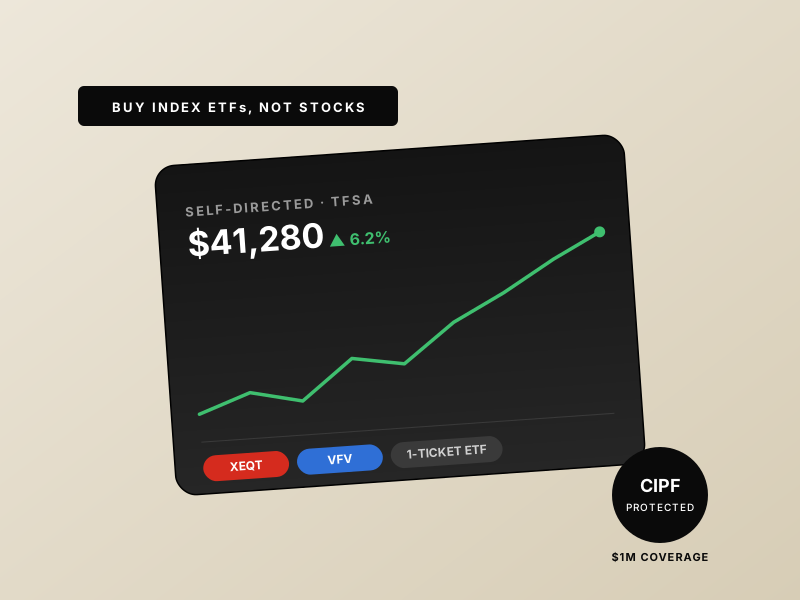
By now you know which registered accounts to fund (Issue 02) and where your cash should live (Issue 09). The missing step is the one that intimidates people most: opening a brokerage and actually buying something. It's simpler than it looks.
Two truths up front. First, the broker you pick matters far less than the fact that you start — the differences between the big three are real but small for a beginner. Second, what you buy matters more than where you buy it, and the right answer for most newcomers is delightfully boring. Here's the comparison, the traps, and the playbook.
Which brokerage should a newcomer open first?
For most newcomers, the simplest one you'll actually use — Wealthsimple — is the best first brokerage: commission-free, fully digital, and it holds TFSA, FHSA, RRSP, and non-registered accounts in one app. Questrade is a solid middle ground with more control and free ETF purchases. Interactive Brokers is best if you have US ties or trade multiple currencies. All three are CIPF-protected up to $1 million.
The paralysis newcomers feel here is usually misplaced. You are not making a permanent decision — accounts transfer between brokers later if you outgrow one. Pick the one whose friction is lowest for you today, fund a registered account, and buy one diversified ETF. You can optimise brokers in year three; the cost of waiting a year to start is far larger than any fee difference between them.
What actually matters when choosing a broker
Four things: (1) commissions — is buying ETFs free? (2) which account types it offers (TFSA, FHSA, RRSP, RESP, margin); (3) how painful it is to open and fund as a newcomer; and (4) how it handles US dollars, which matters if you'll hold US-listed investments. Everything else — fancy charts, research tools — is noise for a long-term index investor.
A newcomer-specific note on funding: all three brokers let you link a Canadian bank account and transfer in. If you're funding from savings still sitting abroad, convert through Wise (referral) or Norbert's Gambit rather than a bank wire — Issue 03 has the step-by-step, and the savings on a large transfer dwarf any trading commission you'll ever pay.
Wealthsimple — the easy default
Wealthsimple is the easiest first brokerage for most newcomers: commission-free stock and ETF trades, no account minimum, and a clean app that opens TFSA, FHSA, RRSP, and non-registered accounts in minutes. It also offers a fully managed (robo-advisor) option if you'd rather not pick anything yourself. The trade-off is fewer advanced order types and tools — which most long-term investors never need.
For a newcomer who already opened an FHSA or TFSA in the Wealthsimple (referral) app (as we suggested in Issue 02), keeping the brokerage there too means one login for banking-style cash, registered accounts, and investing. Simplicity has real value when the alternative is not starting at all. If you want it to run on autopilot, the managed portfolios pick and rebalance a diversified mix for a small annual fee.
Questrade — the middle ground
Questrade suits newcomers who want more control and lower costs on larger balances: buying ETFs is commission-free (you pay a small commission only when selling), it supports RESP and margin accounts that some app-first brokers don't, and its USD handling is better for holding US-listed ETFs. The interface is a step more complex than Wealthsimple's, but far from intimidating.
Questrade is the classic "graduate" broker — plenty of long-term Canadian investors use it for the free ETF purchases and the wider account menu. If you plan to hold US-listed ETFs and want to minimise currency conversion, it's a better fit than a purely app-based broker. For a first, set-and-forget TFSA of Canadian-listed ETFs, though, the difference versus Wealthsimple is marginal.
Interactive Brokers — for cross-border and multi-currency
Interactive Brokers (IBKR) is the pick if you have US ties — a US brokerage to transfer in, US-dollar income, or plans to hold significant US-listed assets. Its currency conversion is the cheapest in the market by a wide margin, and it supports almost every account type and market. The catch: the platform is built for active traders and has the steepest learning curve of the three.
For a FAANG/tech transferee arriving with a US investment account or RSUs vesting in USD (see Issue 05), IBKR's cheap FX and cross-border reach can save real money. For a newcomer who just wants a TFSA with one Canadian ETF, it's more power than you need — start simpler and move here later if your situation demands it.
What to actually buy in your first account
For most people: one broad-market, low-fee index ETF — or a single one-ticket asset-allocation ETF (such as XEQT or VEQT) that holds thousands of global stocks in one fund and rebalances itself. It's diversified, cheap, and needs no maintenance. Avoid picking individual stocks in your first year; the odds a beginner beats a low-cost index fund are slim.
The "one-ticket" asset-allocation ETFs are the single best thing to happen to beginner investing in Canada. You buy one fund; it holds a globally diversified basket of stocks (and bonds, in the more conservative versions) and rebalances automatically. Names like XEQT and VEQT are all-equity; their VGRO/XGRO siblings add bonds for lower volatility. Pick one that matches your risk tolerance, buy it every payday, and ignore the news. That's the entire strategy for the first several years — and it quietly beats most people who try to do something cleverer.
The newcomer traps: TFSA rules and US dividends
Two traps cost newcomers real money. First, don't day-trade inside a TFSA — the CRA can reassess frequent trading as business income and strip the tax-free status. Second, US-listed stocks and ETFs pay a 15% US withholding tax on dividends inside a TFSA that you can't recover, but that withholding is waived inside an RRSP under the Canada-US tax treaty.
The practical implications:
- Keep the TFSA for long-term holding, not trading. Buy-and-hold index ETFs are exactly what it's designed for. High-frequency trading risks a CRA reassessment (CRA: TFSA).
- Put US-dividend-heavy holdings in the RRSP where you can. The 15% treaty exemption applies to US-listed securities held directly in an RRSP. In a TFSA, that 15% is a permanent drag on US dividends.
- Canadian-listed ETFs sidestep the paperwork. A Canadian-listed global ETF like XEQT is the simplest default for a TFSA — no US forms, still globally diversified (though US withholding still applies indirectly on the US portion; the simplicity is usually worth it for a beginner).
- It's not tax advice. Cross-border tax (especially if you're a US person) gets complicated fast — one hour with a cross-border accountant is cheap insurance.
The brokerage playbook
The clean sequence: (1) open a brokerage — Wealthsimple if you want easy, Questrade for more control, IBKR for cross-border; (2) open a TFSA (or FHSA/RRSP) inside it; (3) fund it from your Canadian bank; (4) buy one broad-market or one-ticket index ETF; (5) set up an automatic contribution every payday and leave it alone. Confirm the broker is a CIPF member first.
- Pick a broker and open an account. Don't agonise — Wealthsimple for most, Questrade or IBKR if you have a specific reason. Check CIPF membership on the CIPF site.
- Open the right registered account inside it. TFSA and FHSA first for most newcomers (Issue 02), within your contribution room.
- Fund it. Link your no-fee chequing account (Issue 09); convert foreign money via Wise or Norbert's Gambit, not a bank wire.
- Buy one diversified ETF. A one-ticket asset-allocation fund matched to your risk tolerance. One order, done.
- Automate and ignore. Set a recurring contribution every payday. The hardest part of investing is doing nothing — automation does it for you.
Where to go next
The full first-year sequence lives in the complete newcomer money guide. With banking, accounts, and now investing in place, the next foundation is credit — building a Canadian score from zero, which we'll cover next. Missed an earlier step? Start with registered accounts (Issue 02).
This issue is general information, not investment or tax advice. Investments can lose value, and your situation (especially US citizenship) can change the right answer — confirm specifics before you act.
Got a question this issue didn't answer? Reply to any First Year Canada email or write to [email protected]. Reader questions become future issues.
— Sushil